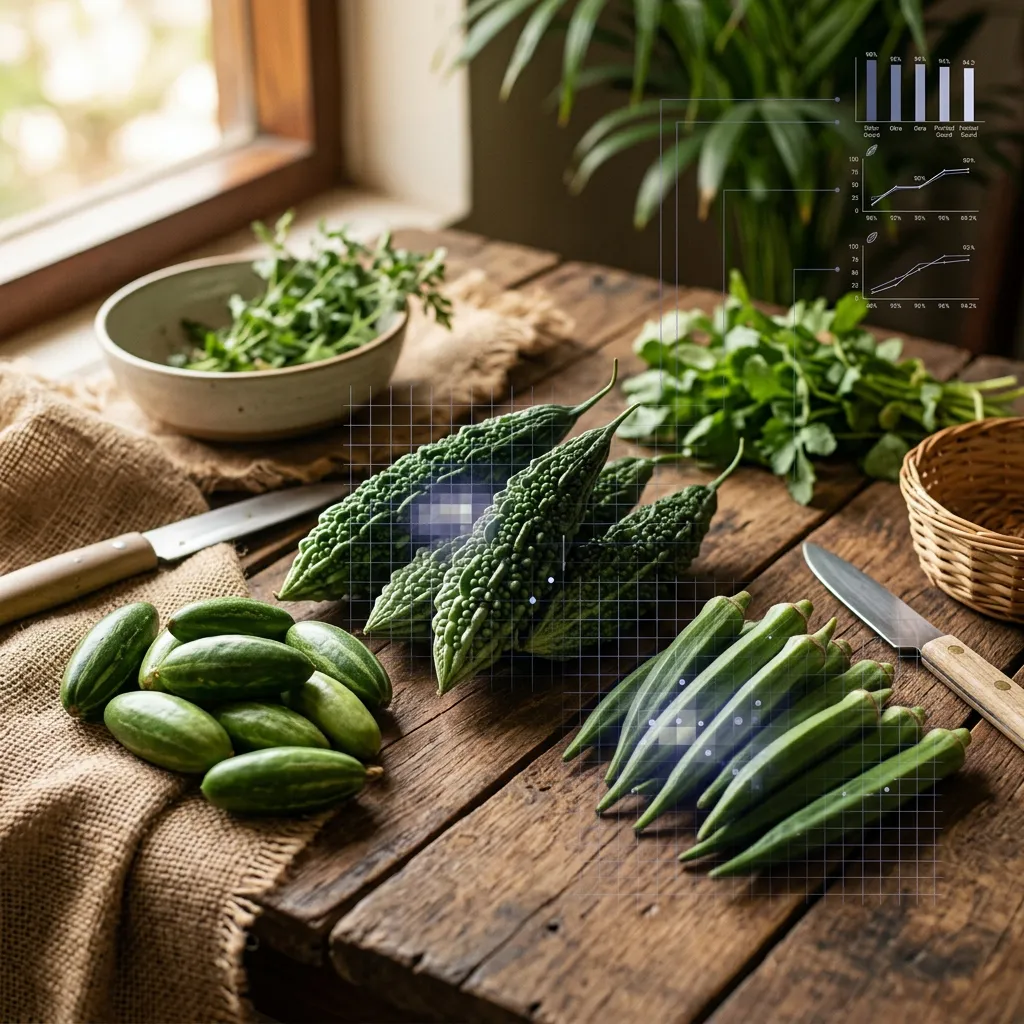
Local Crop Classifier — Edge CNN Architecture Study
Computer vision models trained on clean laboratory datasets experience severe performance degradation when exposed to real-world farm and market conditions with harsh shadows, occlusions, and variable lighting.
My Role & Contribution
Solo Developer & Researcher: Curated and labeled 1,200+ regional crop photos (Karela, Parwal, etc.), implemented OpenCV background segmentation, trained six CNN variants in PyTorch, and built a Flask evaluation UI.
Proposed Solution
Captured and normalized 1,200+ vegetable photos under multiple real-world lighting conditions. Benchmarked lightweight depthwise-separable architectures against heavier residual models to pinpoint the optimal Pareto frontier between classification accuracy and edge inference latency.
- Curated custom dataset of 1,200+ high-resolution photographs under variable outdoor and wholesale market lighting
- Comparative benchmark across 6 network designs, evaluating accuracy, parameter footprint, and CPU latency
- OpenCV preprocessing pipeline with HSV color segmentation and adaptive background isolation
- Lightweight Flask web interface for real-time model validation and latency profiling
Architecture & Dataflow
Engineering Trade-offs & Limitations
Rationale:Traded absolute top-1 laboratory accuracy for robust generalization across variable illumination through aggressive affine data augmentation and color-jitter transforms.
Results & Evaluation
Demonstrated viable edge classification performance on regional produce varieties, establishing reproducible guidelines for low-cost agricultural sorting prototypes.