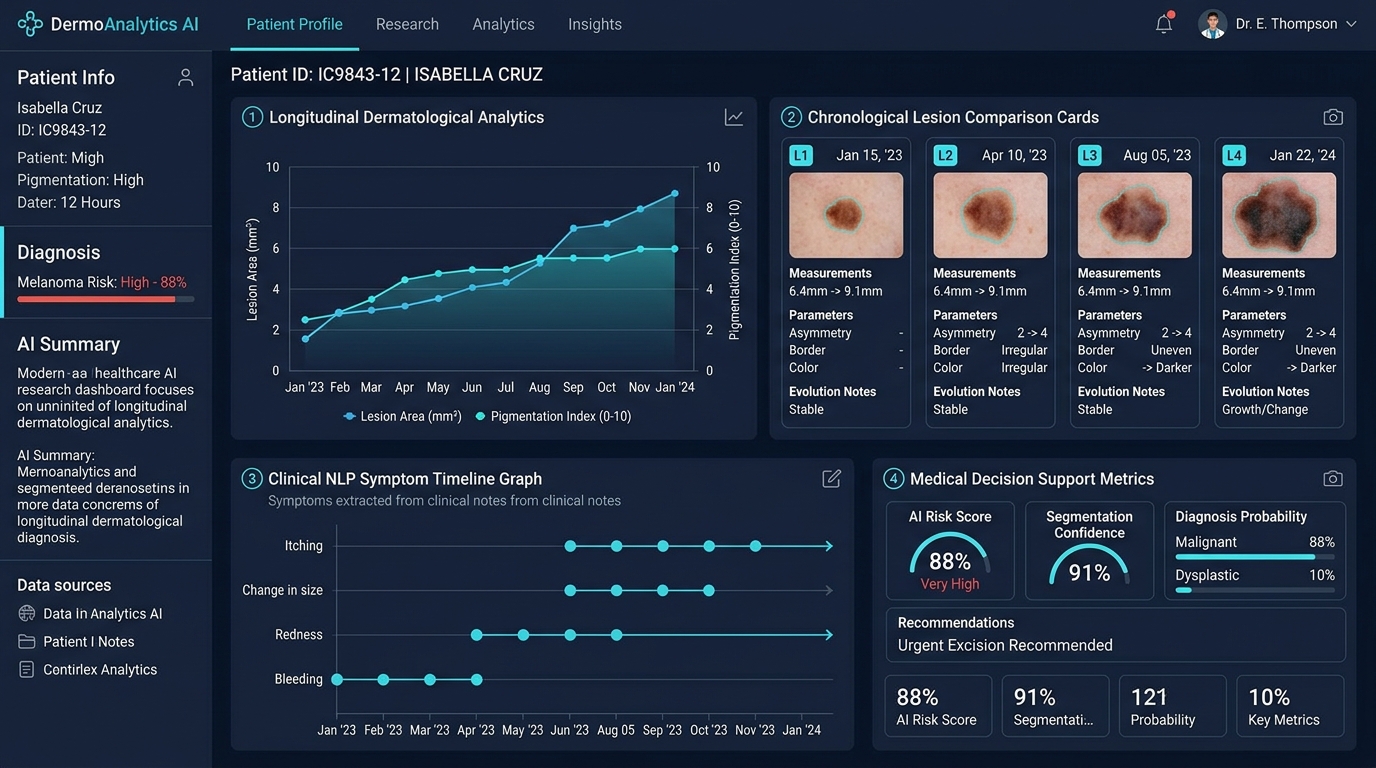
DermaJourney — Longitudinal Dermatology AI Research
Chronic dermatological disorders require continuous tracking over months, yet existing AI diagnostic tools operate as isolated, single-point image classifiers that ignore temporal disease progression and patient clinical histories.
My Role & Contribution
Research Lead: Conceptualized the multi-modal longitudinal decision support framework, defined clinical NLP symptom timeline schemas, and designed the sequential lesion tracking workflow.
Proposed Solution
Formulated DermaJourney as a longitudinal decision support methodology. The system models patient cases as temporal sequences, linking clinical text narratives with aligned dermoscopic photographs to compute delta features that highlight meaningful clinical shifts over time.
- Longitudinal decision support framework tracking lesion changes across sequential clinic visits
- Clinical NLP feature schema extracting structured symptom chronologies from unstructured patient notes
- Comparative image alignment framework highlighting morphological changes (border, asymmetry, color shifts)
- Responsible medical research framework strictly designated for clinical decision support without autonomous diagnostic claims
- Privacy-centric architecture keeping all patient data anonymized and research-confined
Architecture & Dataflow
Implementation Status & Roadmap
Implemented
- Longitudinal data schema modeling chronic skin condition progression
- Clinical NLP text extractor mapping symptom timelines (erythema, pruritus, scaling)
- Dermoscopic feature delta framework calculating change metrics between check-ins
Planned Roadmap
- Transformer-based temporal lesion tracking model validated on open clinical datasets (ISIC Archive)
- Integration with FHIR healthcare interoperability data standards
- Clinician-in-the-loop review interface with uncertainty estimation
Engineering Trade-offs & Limitations
Rationale:Prioritized interpretability and clinician-in-the-loop decision support over black-box automated triage. The architecture presents evidence, change metrics, and uncertainty bounds rather than arbitrary certainty scores.
Results & Evaluation
Established a rigorous methodological framework for longitudinal healthcare AI evaluation. Framed responsibly as an academic research concept requiring controlled clinical trials before any real-world healthcare deployment.